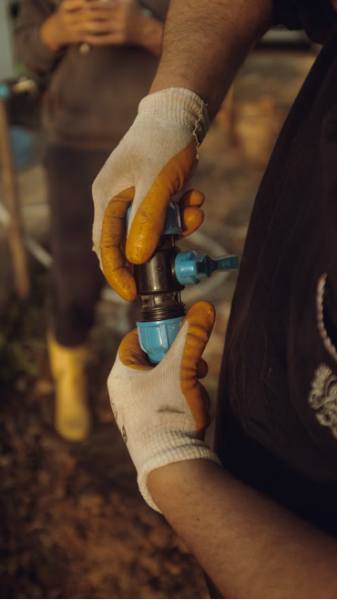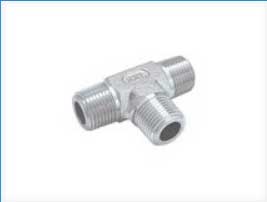
Walk a shop floor and count the joints in a single compressed-air run. Most plants have more than the drawing shows because operators add quick connections over the years wherever a tool needed feeding. Each of those points is a quick decision someone made. Choosing between stainless steel pipe fittings in India and pneumatic couplings comes down to a question few people ask before ordering: how often anyone will actually take that joint apart.
Get it wrong one way and maintenance crews spend hours breaking sealed joints that should have opened by hand. Get it wrong the other way and a header full of pneumatic couplings bleeds air continuously through seals that were never meant to sit permanently under pressure. Stainless steel pipe fittings in India cost more upfront at a fixed point and less over ten years.
When Fixed Pipe Fittings Make Sense
Some joints never need opening. Main headers, riser drops, manifold inlets, and anything buried behind machine guarding all fall into that group.
Threaded or welded pipe fittings suit those positions because they seal on metal and stay sealed. No elastomer sits in the load path, so nothing compresses over five summers.
- Distribution headers running across a bay
- Branch takeoffs feeding fixed equipment
- Any joint above ceiling height or behind panels
- Connections in wash-down zones where crevices collect residue
Here is the part buyers miss. A fixed joint costs labor to make and almost nothing after that. A disconnectable joint costs less to make and carries a recurring seal replacement cost forever.
Where Pneumatic Couplings Earn Their Place
Quick connect pneumatic couplings exist for a reason: changeover time.
Hand tool stations, test rigs, mold changes, portable equipment, and machines rolled between cells all need a joint an operator can break in two seconds without tools. Fitting those points with threaded connections wastes far more than the coupling ever leaks.
Think about a plant running three shift changeovers a day on a packaging line. Perhaps forty disconnections daily. Nobody is unthreading pipe fittings forty times a day.
The trade-off is honest and worth stating. Couplings restrict flow more than an equivalent pipe fitting, because the internal valve and sleeve reduce the effective bore; on a large tool, that restriction shows up as reduced performance.
Seal Life and Flow Loss on Coupled Joints
Coupling seals wear because they move. Every connection drags the O-ring across a sealing face, and every disconnection lets a small volume of air escape.
Individually, those losses are small. Across two hundred coupling points on a large plant, they stop being small, since compressed air remains one of the costliest utilities running in an Indian factory.
Schedule seal inspection on high-cycle couplings rather than waiting for audible leaks. A coupling that whistles has been losing air for weeks already.
Material choice matters here too. Stainless steel bodies survive repeated sleeve actuation better than plated brass, which wears through its plating and then corrodes at the wear point.
Wrapping Up
Sealexcel manufactures stainless steel quick-connect couplings, precision pipe fittings, push-in and push-on fittings, flow control regulators, quick exhaust valves, pneumatic check valves, needle valves, and 2/3-way ball valves at its facilities in India.